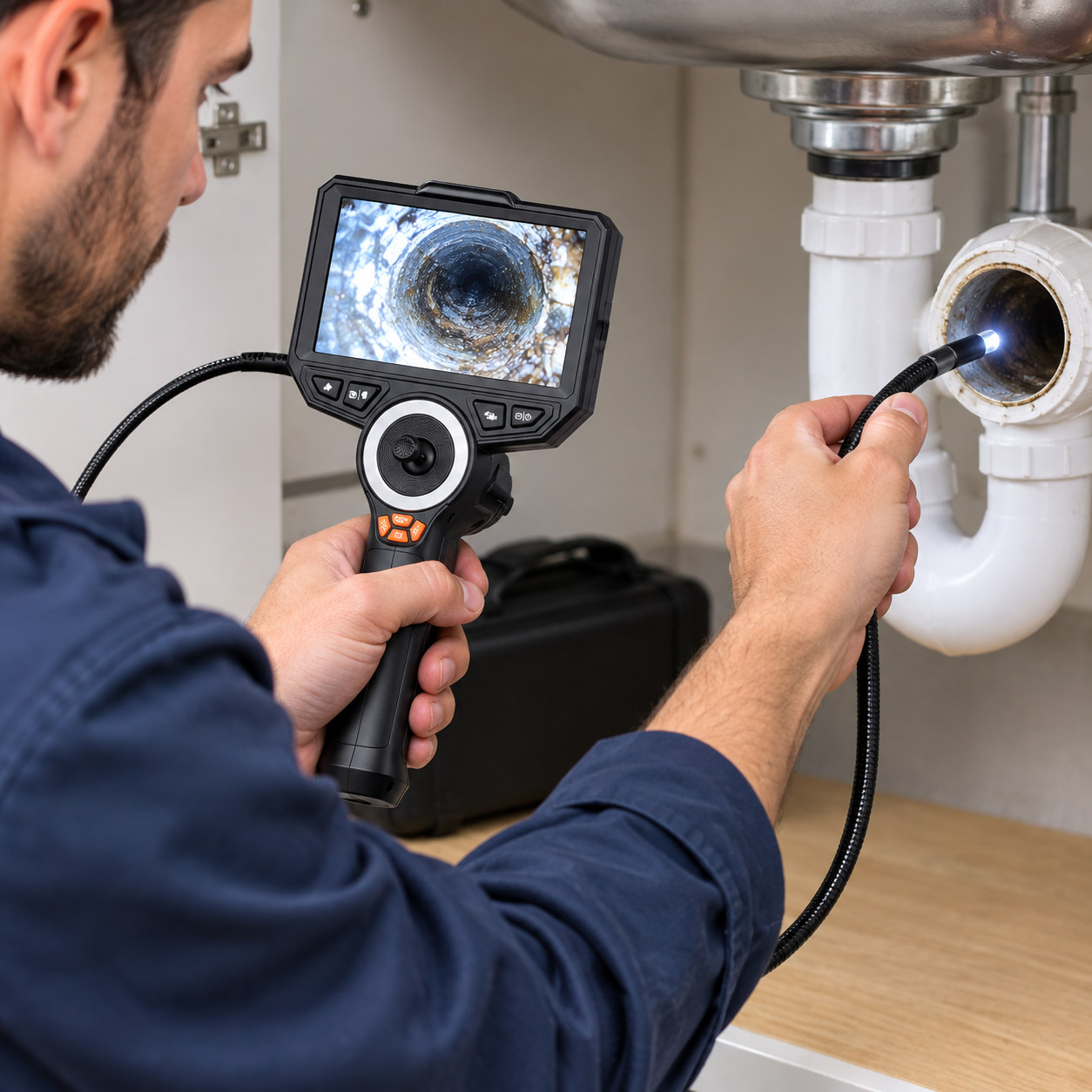
Plumbing problems are not always visible from the outside. A blocked pipe, damaged connection, buildup, or hidden obstruction can be located inside a narrow space where traditional inspection methods are difficult to use. This is where a plumbing borescope can make a significant difference. By allowing users to see inside pipes and other hard-to-reach areas, a borescope can provide useful visual information without requiring immediate dismantling of the plumbing system.
Choosing the right camera, however, is not simply a matter of picking the model with the longest cable or the highest number of pixels. Different plumbing jobs have different requirements. Cable length, camera diameter, lighting, screen quality, flexibility, image recording, and camera design can all influence how useful the equipment will be during an inspection.
Table of Contents
ToggleWhy Use a Borescope for Plumbing Inspection?
Traditional plumbing inspections often involve checking accessible sections of a system and trying to determine what may be happening farther inside. Unfortunately, the most important problem may be located beyond the area that can be seen directly.
A borescope provides another option. A small camera attached to a flexible insertion cable can be guided through an opening, allowing the user to inspect areas that would otherwise be difficult or impossible to see.
This can be useful when investigating suspected blockages, checking the inside of pipes, examining connections, or looking for signs of damage. The camera does not necessarily solve the plumbing problem by itself, but it can provide valuable information before deciding what action to take.
Consider the Camera Diameter
One of the first specifications to check is the diameter of the camera head. Plumbing systems can contain relatively narrow passages, so a camera that is too large may not be suitable for a particular inspection.
A smaller camera head can make it easier to access tight openings and narrow pipes. However, reducing the camera size may involve compromises in other areas, such as lighting or image quality.
The right diameter depends on the type of plumbing being inspected. Before purchasing a borescope, it is useful to consider the smallest opening through which the camera will need to pass.
Cable Length Matters
The insertion cable determines how far the camera can travel into a pipe or other enclosed area. A short cable may be perfectly adequate for basic household inspections, while longer plumbing systems may require considerably more reach.
However, maximum cable length should not be the only consideration. A very long cable is useful only if it remains manageable during the inspection.
The ideal length should provide enough reach without creating unnecessary handling difficulties. For professional work, having sufficient cable length can be particularly useful when dealing with longer pipe runs or areas that are difficult to access from multiple points.
Look for a Flexible but Manageable Cable
Flexibility is another important feature. The cable needs to move through bends and changes in direction without becoming impossible to control.
A cable that is too stiff may struggle with curved pipe sections. On the other hand, a cable that is extremely flexible may be difficult to push through longer sections.
The best balance depends on the application. For plumbing inspections involving multiple bends, a flexible insertion cable can make navigation easier. For longer and relatively straight runs, some additional stiffness may help the user push the camera farther into the pipe.
Lighting Is Essential
Pipes and enclosed spaces are naturally dark, so the camera needs its own source of illumination. Many inspection cameras use small LED lights around the camera lens.
Adjustable lighting can be especially useful because different surfaces reflect light differently. A highly reflective pipe interior may require less illumination, while a dark or dirty area may require more.
Good lighting does not necessarily mean using maximum brightness all the time. Excessive light can sometimes create reflections that make details harder to interpret.
A camera with adjustable LEDs gives the user more control over the image and can make inspections easier in different conditions.
Image Quality and Display
Image quality is another factor worth considering. The camera should provide enough detail to identify the features relevant to the inspection.
A clear image can make it easier to distinguish between normal pipe surfaces, buildup, cracks, objects, and other potential issues.
The screen itself also matters. A small display may be convenient for portability, but a larger screen can make details easier to view during a professional inspection.
For field work, a built-in display can be particularly convenient because it eliminates the need to connect the camera to another device simply to see the live image.
When a Dual-Lens Camera Can Help
Some modern inspection cameras feature more than one lens. A dual-lens design can provide different viewing directions without requiring the entire camera to be repositioned.
This can be useful when inspecting areas where visibility is limited. For example, one lens may provide a forward-facing view while another offers a side or alternative perspective, depending on the design.
Having multiple viewing options can reduce the need to repeatedly manipulate the cable. This can make the inspection process more efficient, particularly in complicated spaces.
Recording and Capturing Images
A camera that allows images or videos to be recorded can be useful for documentation. Instead of relying entirely on memory, the inspector can save visual information for later review.
Recorded footage can also help when explaining a plumbing issue to a customer or when comparing the condition of a pipe before and after maintenance.
Storage options and file formats should be considered if recording is an important part of the workflow. The camera should provide enough storage capacity or a suitable method for transferring files.
For occasional household use, recording may not be essential. For professional inspections, however, it can become a valuable feature.
Choosing a Plumbing Inspection Camera
At the middle of the selection process, it is important to think about the exact jobs the equipment will perform. A plumbing inspection camera intended for occasional household checks does not necessarily need the same specifications as equipment used every day by a professional plumber.
Consider the types of pipes, typical inspection distances, pipe diameters, and working environments involved. If inspections regularly involve narrow passages and multiple bends, camera flexibility and diameter may deserve greater attention.
If documentation is important, recording capabilities and image quality become more relevant. If the equipment is used in different locations, battery life, portability, and screen design can also influence the choice.
In other words, the best specification is the one that solves the actual inspection problem rather than simply offering the highest advertised number.
Battery Life for Field Work
For portable inspection equipment, battery life can have a direct effect on usability. A camera that runs out of power halfway through an inspection can create unnecessary delays.
Think about how long a typical inspection lasts and whether several jobs may be completed before the equipment can be recharged.
A rechargeable battery can be convenient for regular use, especially when the camera is frequently transported between different locations.
It is also worth considering how the charging system fits into the working environment. USB charging, for example, can provide flexibility when suitable power sources are available.
Water Resistance and Durability
Plumbing inspection equipment may be exposed to moisture, dirt, and other challenging conditions. The camera head should therefore be designed for the environment in which it will be used.
Water resistance is particularly relevant when inspecting damp areas or pipes containing residual moisture. However, water resistance ratings have specific limits, so users should always check the manufacturer’s specifications rather than assuming that any inspection camera can be submerged indefinitely.
The insertion cable and other components should also be handled carefully. Repeated bending, twisting, or pulling beyond the equipment’s intended limits can reduce its service life.
Ease of Operation
A professional-looking device is not necessarily a practical one. The controls should be straightforward enough that the user can concentrate on the inspection rather than figuring out how to operate the camera.
Useful controls may include brightness adjustment, image capture, video recording, lens switching, and screen controls.
Buttons that can be identified easily while wearing work gloves can also be helpful in some plumbing environments.
The overall design should support the way the equipment will actually be used.
Inspecting Different Types of Plumbing
Not every inspection involves the same type of pipe. Residential plumbing, drainage systems, HVAC-related passages, and industrial applications can all present different challenges.
For smaller household pipes, a compact camera head may be more important than extreme cable length.
For larger or longer systems, reach and cable control may become more important.
Understanding the typical inspection environment before buying the camera can therefore prevent the user from paying for features that will rarely be used.
How to Prepare for an Inspection
A little preparation can make an inspection more effective. First, identify the area where the camera can safely be inserted. Make sure the access point is suitable and that the camera is compatible with the opening.
The insertion cable should be guided gradually rather than forced. If resistance increases significantly, pulling back slightly and changing the angle may be more appropriate than applying excessive force.
The screen should be monitored continuously so the user knows where the camera is and what it is seeing.
Taking notes or recording important sections can also make the inspection easier to review later.
Common Mistakes to Avoid
One common mistake is choosing a camera based solely on resolution. A high-resolution camera is useful, but it cannot compensate for a camera head that is too large or a cable that cannot navigate the required pipe.
Another mistake is ignoring lighting. Even a good camera will struggle to produce a useful image if the inspection area is poorly illuminated.
Cable length is also sometimes misunderstood. More length is not automatically better if the cable becomes difficult to control.
Finally, users should avoid forcing the camera through tight bends or obstructions. Inspection equipment should be used within its intended operating limits to avoid damaging the camera or the plumbing system.
Final Thoughts
A good borescope can make plumbing inspections faster, more informative, and less disruptive by providing a view of areas that cannot easily be examined from the outside. The most suitable model depends on the inspection environment, pipe dimensions, required reach, cable flexibility, lighting, image quality, battery life, and recording requirements.
For longer or more demanding inspections, a pipe inspection borescope camera can provide the reach and visibility needed to examine difficult sections of a plumbing system. By focusing on the actual requirements of the job rather than simply choosing the camera with the longest cable or highest specifications, users can select equipment that is practical, reliable, and easier to use in real-world plumbing work.