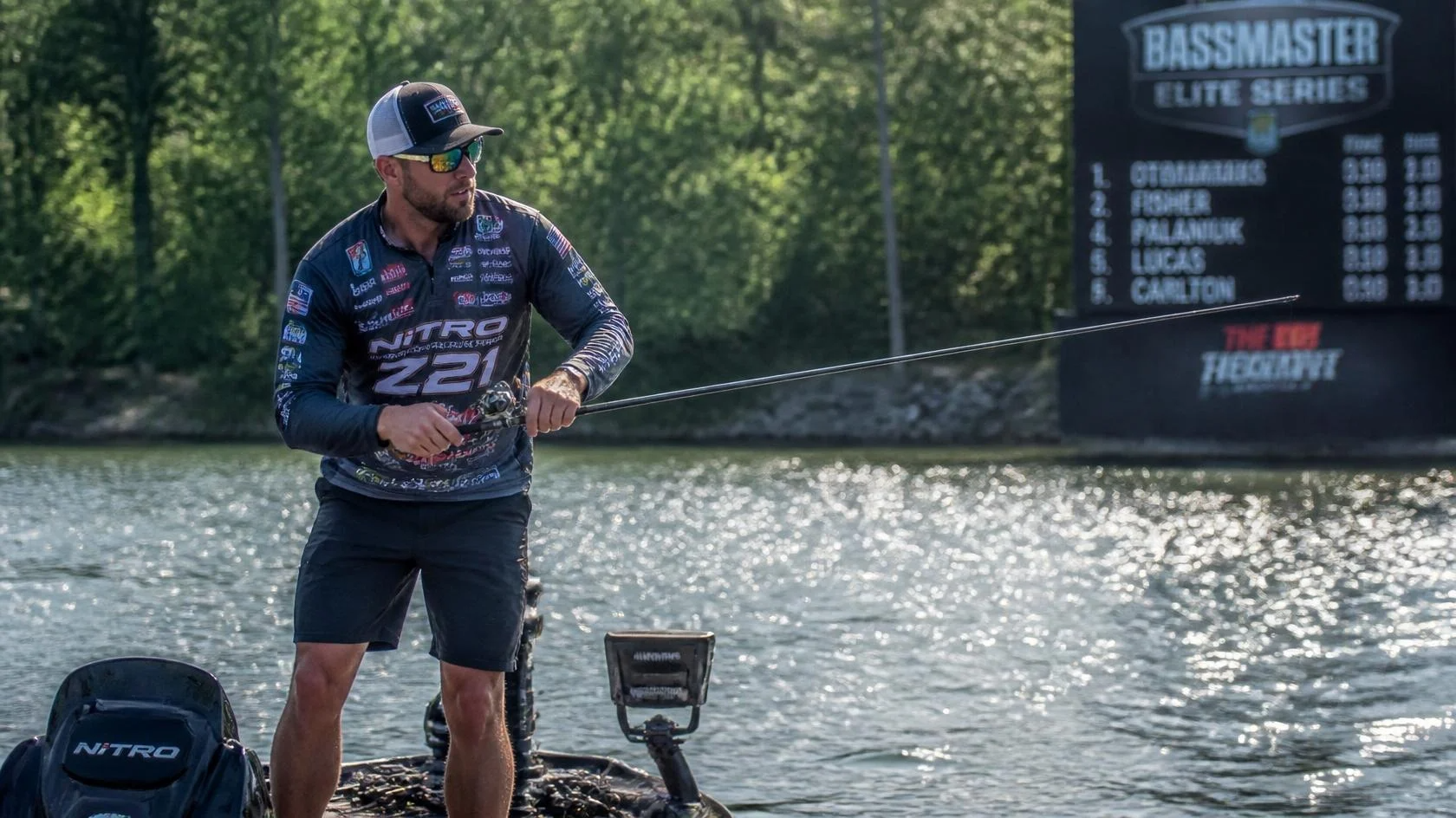
Count the casts sometime. A bass angler working a jig through a practice day will throw somewhere between 1,500 and 2,500 times before the tournament even starts. Add three competition days on top, and the shoulder in question has performed the same loaded rotation more times in a week than most gym-goers manage in a year.
Fishing rarely gets classified as an endurance sport, mostly because the marketing photos show somebody sitting down. The reality on a tournament deck looks different: ten hours standing on an unstable surface, a 65 mph run across chop to the next spot, repeated hooksets, and the fine motor control to work a bait properly at hour nine when the forearms have stopped cooperating.
Anglers who compete regularly tend to figure this out the hard way, usually in the form of an elbow that will not settle down. The good news is that most of it is preventable, and the fix is far less complicated than the injury.
Table of Contents
ToggleWhat a tournament week does to a body
The physical load in competitive fishing arrives from four directions, and they stack.
Repetition is the obvious one. Casting is a compound movement involving the shoulder, elbow, and wrist, repeated under light load thousands of times. Light load and high volume is the classic recipe for tendon overuse, which is why fishing produces the same elbow complaints as tennis and golf and for exactly the same mechanical reasons.
Vibration is the underrated one. Running a boat at speed across a chop transmits impact through the legs, spine, and hands continuously, and after two hours of it the stabilising muscles around the lower back are simply tired. Anyone who has stepped off a boat at the end of a long run and felt their legs buzzing has felt that load directly.
Static holding does the rest. Standing on a casting deck with knees soft and core braced for ten hours is an isometric endurance task, and the trolling motor foot means most anglers do it with weight unevenly distributed to one side. That asymmetry shows up later as a hip that feels tight on only one side.
Then there is the sleep. Practice days start at four, weigh-ins run late, and tournament nights get spent re-tying and re-rigging. Recovery capacity drops precisely when demand peaks.
The injuries that end seasons
The most common complaint is lateral epicondylitis, known universally as tennis elbow, which involves degeneration at the common extensor tendon on the outside of the elbow. Anglers who fish heavy jigs or work a baitcaster with a firm palming grip see it most. The medial version, golfer’s elbow, turns up in fly anglers and anyone doing high-volume false casting. Both develop slowly, get ignored, and then become genuinely stubborn. The Mayo Clinic notes that these tendon problems typically respond to load management and conservative treatment, and that the ones which drag on for months are usually the ones that got pushed through in the early stage.
Shoulders come second, generally as rotator cuff irritation from repeated overhead and cross-body casting on a deck that keeps moving underneath. Wrists show up third, particularly de Quervain’s tenosynovitis on the thumb side from reeling and from thumbing a spool all day.
Lower backs round out the list. Standing all day, twisting to net a fish, and lifting a full livewell bag at weigh-in is a combination that finds any existing weakness.
Where sports massage fits
Sports massage is not a luxury rub. The techniques used are specific: cross-fibre friction across a tendon, sustained pressure on trigger points, active release where the therapist pins tissue while the client moves the joint through range.
What it does well is restore tissue extensibility and identify problems early. A therapist working a forearm regularly will find a thickened, tender band at the extensor origin weeks before it becomes an elbow that cannot lift a coffee cup. That early warning is arguably worth more than the treatment itself.
The evidence base is honest rather than spectacular. Research summarized by the American Massage Therapy Association supports massage for muscle soreness, pain, and perceived recovery, while the older claims about flushing lactic acid have not held up. For an angler who needs to fish competently for three consecutive days, reduced soreness and better range of motion is the outcome that actually matters.
Timing it around a tournament
Getting the schedule wrong turns a useful treatment into a liability. Deep work creates temporary soreness, and nobody wants that on day one of a three-day event.
- Four to seven days out: the window for deep tissue work, friction techniques, and anything aggressive. Time enough to recover from the treatment itself.
- The night before: light flushing work only. Moderate pressure, focus on shoulders, forearms, and lower back, thirty to forty-five minutes.
- Between competition days: short and gentle. Fifteen minutes of forearm and shoulder work beats an hour of deep tissue every time.
- After the event: whatever is needed. This is the appointment to book properly.
Anglers who travel for competition tend to keep a short list of places they can book in the cities they route through. For anyone passing through London for a trade show, a connecting flight, or a European trip, a session of massage in nuru london sits within walking distance of most of the central hotels, which matters more than it sounds like it should when the alternative is a cross-city journey on tired legs.
Self-care between the appointments
Professional treatment covers a fraction of the calendar. The rest happens in a truck or a hotel room.
Forearms respond well to a lacrosse ball rolled on a table, working from just below the elbow toward the wrist, pausing on the tender spots for fifteen seconds while opening and closing the hand. Shoulders benefit from a doorway pec stretch held for thirty seconds each side, since a tight chest pulls the shoulder forward and narrows the space the rotator cuff needs. Lower backs want hip flexor length, not more stretching of the back itself.
Grip strength deserves mention too. Anglers with strong grips but weak wrist extensors are the ones who develop elbow trouble, so a set of light reverse wrist curls twice a week is cheap insurance. So is a cast that uses the wrist and forearm rather than the whole shoulder, which most anglers can adopt with a few hours of deliberate practice.
Fishing the long season
A tournament schedule is a physical commitment, and treating it as one changes results in a way that new tackle rarely does. The anglers still fishing competitively into their sixties are not the toughest ones on the ramp. They are the ones who dealt with the sore elbow in March instead of nursing it through October.
Book the session, keep the ball in the truck, and stretch the hip flexors that ten hours of standing quietly shortened. The fish will still be there. Whether the shoulder is depends largely on decisions made now.